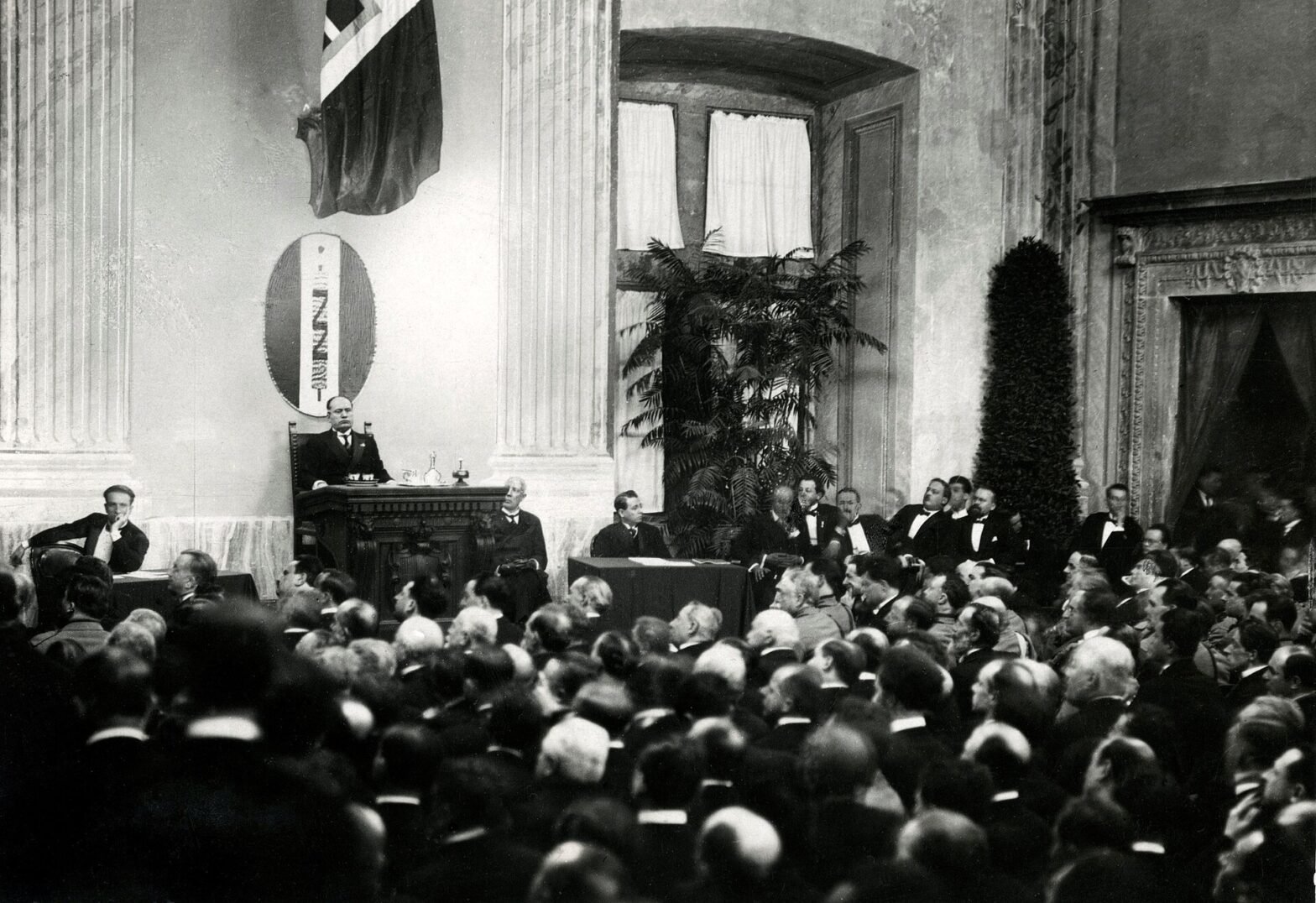
What we hear now is ‘Make America great again’. Almost a century ago Mussolini too had a similar idea of rebuilding Italy.
One of the most infamous dictator Benito Mussolini, who ruled Italy as ‘Prime Minister’ for nearly 21 years, would say the same for Italy. His authoritarian rule began in October 1922 following the March on Rome. The March that inspired Hitler in conducting the Munich Putsch.
However, it is fascinating to look upon shift in Mussolini’s political ideas from the 1919 elections until the March. Until the first world war , Mussolini was a socialist, part of the PSI (Socialist Party). Later expelled for supporting the interventionists. The interventionists wished for Italy to join the war for territorial gain. On the contrary PSI, Catholics and many liberals feared intervening would only worsen the standard of living in Italy.
After his expulsion Mussolini gradually moved towards nationalism, later founding his own political group Fasci di Combattimento. This group was the foundation of Fascism that held Italian reins for the next two decades.
Early fascism was unclear in deciding its ideology due to Mussolini’s belief inaction, indicating the disorganised start of the movement. For the 1919 elections Fascist manifesto included the following:
- Universal Suffrage – to all citizens 18 and over
- Minimum wages
- Women’s Rights
- Seizure of Church
While Fascist presented these progressive ideas the rest didn’t accept it. Causing Mussolini to drastically lose elections, where socialists paraded a coffin with Fasci di Combattimento’s name on it.
As the Beinnio Rosso, or Red Years that brought Italy closest to socialist rule like the Bolsheviks in Russia, continued in 1919 . Some Fascist supporters formed the small squads that attacked Socialist meetings and trade unions, significantly removing the opposition. Group later being known as ‘Squadristi’ or ‘The Blackshirt’ which later inspired Hitler’s SS. Unsurprisingly, the Squadristi was never arrested by the police or army. Due to hate of socialism, causing them to see Fascists as saviours. While Mussolini did not organise the violence, he realised it could be of greater use to Fascism.
The shift of Fascist ideology came in 1921. With the formation of PNF (Partito Nazionale Fascista) , the official party formed by Mussolini. Completely transforming the key beliefs but also the outlook of the party. Fascism was now believed to be an elite movement that would save Italy from the chaos. From 1922 the main Fascist supporters were civil servants, landowners, industrialists, merchants and university students.
Meanwhile in 1920s PM Nitti’s government collapsed and Giovanni Giolitti stepped in to restore order. With Fascists continuing to grow support from any violence at any strikes conducted by Socialists. Fascist violence accelerated to the point of burning down the office of Avanti, a socialist newspaper which Mussolini was previously the editor of.
Mussolini’s final step to gain power came in October 1922, with the March on Rome. During the March, Squadristi attempted to seize buildings, in order to intimidate the government. While there were 30,000 Fascists present, the result of the March was poor as the squads were dangerously ill-equipped if they had to fight. However, Mussolini’s threat was successful despite the unequipped Fascists as most of PM Facta’s government resigned. Following up on the resignation, as Italy was a constitutional monarchy the King Victor Emmanuel III played a vital part in Mussolini’s appoint.
The King refused to sign the Martial law against Fascist, the main reasons for this included him being doubtful of the army’s ability to crush the threat but also their previous sympathy and leniency towards Fascists violence played a large part. Fearing the beginning of a Civil War and the collapsed state of democracy the King finally agreed to appoint Mussolini as the new Prime Minister of Italy. In hopes of being able to control Mussolini and exert more influence on the Fascists. With Mussolini becoming Italy’s youngest Prime Minster at the age of 39.